Most builders still run jobs the way they did a decade ago. The schedule lives in a file. The purchase orders, bid requests, trade confirmations, and client selections live in someone’s head until that person finds a quiet hour.
Quiet hours disappear once you are on eight jobs.
The work that actually slips
A material that never got ordered. A bid request that should have gone out two weeks ago. A sub who never confirmed. A selection sitting with the client past the date the lead time needed.
None of that is mysterious. It is checking. It is chasing. It is writing the PO, the bid request, the schedule change, the reminder. The usual fix is to hire a project manager. Most builders running a handful of jobs cannot justify one, so the owner stays the bottleneck.
Software has not solved this. It stored the jobs. You still had to open the file, notice the miss, and type the thing that fixed it.
An assistant that starts the round
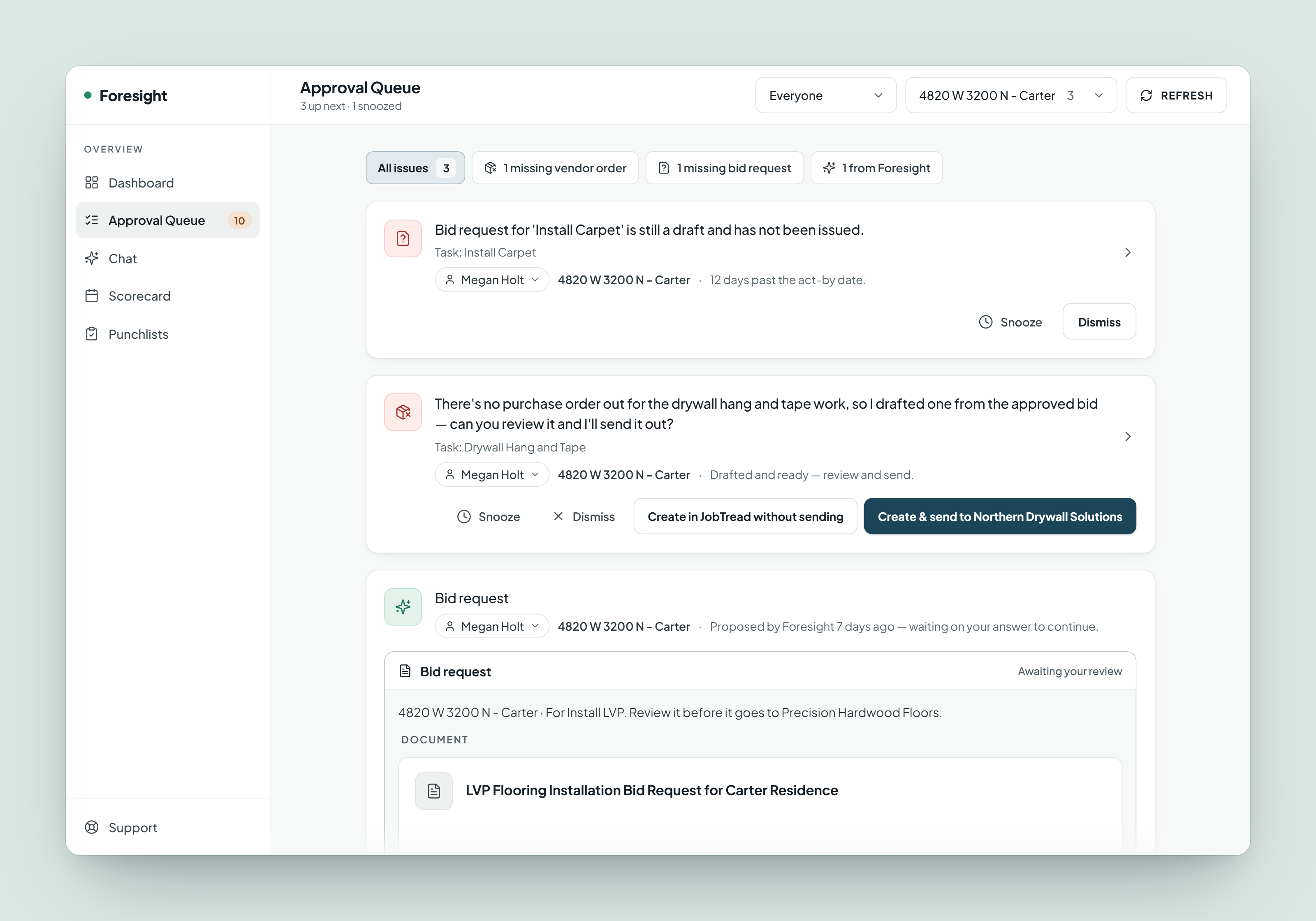
Foresight is a construction management platform with the AI project manager built in. It reads every job. It finds what slipped. It writes the fix. You decide what goes out.
That last part is the job-site rule. Every message, purchase order, bid request, and reminder needs a person to sign off. Foresight drafts. You approve. Approved work runs as the person who approved it, so the history shows who allowed what.
You can ask it questions. “Which jobs are at risk?” “Where are we on the garage doors?” Chat answers from your live jobs. Chat is extra. The product still works if you never type a prompt, because the checks already ran.
What a morning looks like
Foresight checks every active job before you sit down: purchase orders, bids, trade RSVPs, deadlines, selections, material lead times, phase readiness. When something is off, the fix is already in one approval queue. A PO drafted from the winning bid. A bid request with scope and plans attached. A schedule shift that lists every date that moves.
Walk a job and talk. By the time you reach the truck, the notes are to-dos and schedule changes waiting for approval.
A custom home builder running about twelve homes a year put it this way: they used to lose sleep walking every job in their head. Now they look at the state of the work and go to bed.
What you get back
The checking gets done. You stop using the evening to reassure yourself you did not forget a PO.
The fix is already written. Drafting is the part that slips when the day gets loud. If the draft is waiting, a crew is less likely to stand around for a material that never got ordered.
You take on more jobs without the extra hire. Office work grows with every job. That work can land on an assistant that starts at $299 a month instead of another salary. A typical project manager runs about $65K a year before taxes and benefits.
You stay in charge. Edit anything before it sends. Nothing reaches a sub, vendor, or client without a sign-off.
The team sees the same queue. Decisions go to whoever owns them on that job: PM, designer, or purchasing.
The jobs live in Foresight. Schedules, budgets, tasks, selections, comments, and daily logs stay in one place. You enter them once.
Why this is the next way to run a company
Labor is tight. Job counts are up. A large share of PM work is matching a schedule and a budget against what has actually been ordered, bid, confirmed, and selected. People are expensive at that work, and they go home. An assistant can draft it overnight, as long as a builder still makes the call.
The companies that run this way will take on more jobs with the same office, miss fewer lead times, and spend the day on the conversations that need a person.
Foresight is that hire. Book a 20-minute walkthrough and we will run it on your jobs.